Different Types Of Centrifugal Fans, Many Applications
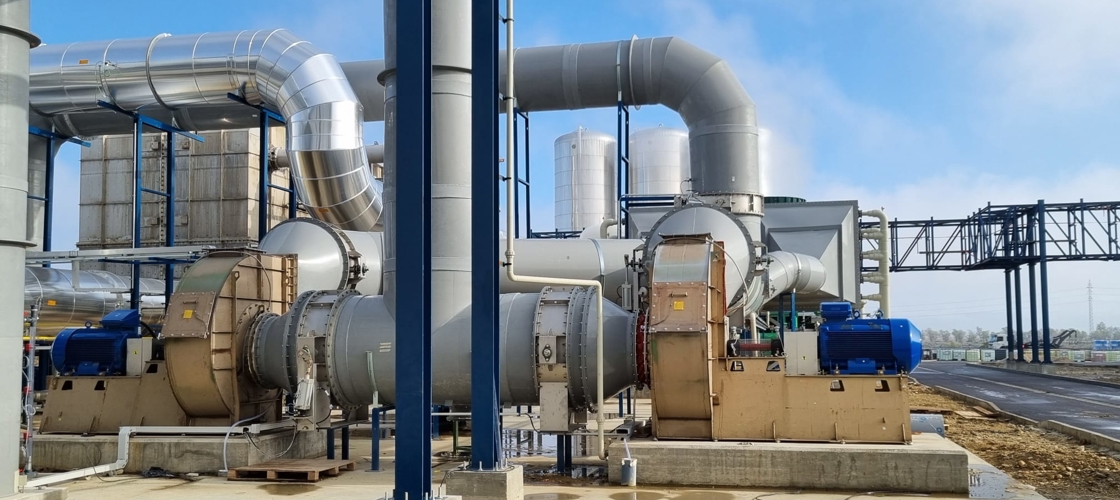
Centrifugal fans have become increasingly important at an industrial level. Renowned for their efficient technological systems and their ability to operate across a wide range of pressures and airflow rates, they represent an ideal solution for specific applications.
These fans move air by converting rotational energy into static pressure. They are primarily classified by impeller design - such as backward-curved, forward-curved, or radial - which dictates their efficiency and pressure capabilities.
In this article, we will discuss:

The 4 Main Types Of Centrifugal Fans
There are four main types of centrifugal fans, each designed to meet specific airflow, pressure and environmental requirements.
Forward-Curved Centrifugal Fan
Forward-curved centrifugal fans are characterised by a large number of small blades that curve in the same direction as the impeller rotation, often compared to a “hamster wheel” configuration.
This type of centrifugal fan is suitable for applications where large volumes of air need to be moved at low pressure. Due to their design, motors may overload if system resistance decreases excessively, making correct system sizing essential.
Typical operating range
-
Static pressure: generally up to 800–1,000 Pa
-
Airflow: high volume at low resistance
-
Power behaviour: risk of motor overload in low-resistance systems
| Key features | Best suited for |
| Compact design and high airflow capacity | General building ventilation |
| Low static pressure | Clean air applications |
| Generally quiet operation at low pressure |
Backward-Curved Centrifugal Fan
Backward-curved centrifugal fans feature fewer and longer blades, curved away from the direction of rotation. This geometry produces a radial airflow while reducing energy losses and improving efficiency.
The impellers can operate with or without a scroll casing, thanks to their ability to generate static pressure efficiently. These fans maintain stable performance and low noise levels even in demanding conditions.
Typical operating range
-
Static pressure: medium to high, up to 3,000–5,000 Pa depending on design
-
Airflow: stable across a wide operating range
-
Power behaviour: non-overloading, peak efficiency at mid-performance
| Key features | Best suited for |
| High energy efficiency | Industrial ventilation systems |
| Stable performance curve | Dust extraction and filtration |
| Lower absorbed power at peak efficiency | Process cooling |
| Reduced noise levels | Air Handling Units (AHUs) |
Radial Centrifugal Fan
Radial centrifugal fans are equipped with straight, paddle-shaped blades extending radially from the hub. Air enters the fan at a 90-degree angle and is expelled radially at high velocity. Thanks to their robust construction, radial fans are particularly suitable for harsh industrial environments and applications involving contaminated air.
Typical operating range
-
Static pressure: high, suitable for severe resistance systems
-
Airflow: medium
-
Air quality: dirty, dusty or abrasive air streams
| Key features | Best suited for |
| Extremely robust design | Material handling |
| High resistance to abrasion | Pollution control |
| Capable of handling particulate-laden air | Combustion air systems |
| Requires a scroll casing to convert velocity into static pressure | Applications with dust, fibres or solid particles |
Aerofoil Centrifugal Fan
Aerofoil centrifugal fans use blades with an aerodynamic profile similar to aircraft wings, designed to minimise turbulence and maximise efficiency. It combines high performance with reduced energy consumption and low noise emissions, provided that it operates with clean air.
Typical operating range
-
Static pressure: low to high, depending on impeller geometry
-
Airflow: medium to high
-
Air quality: clean air only
| Key features | Best suited for |
| Highest aerodynamic efficiency | Clean air ventilation |
| Low noise emissions | Energy-efficient industrial systems |
| Optimised airflow control | Applications where noise reduction is critical |
Comparative overview of all types of Centrifugal Fans
| Fan Type | Blade Design | Pressure | Airflow Volume | Air Quality |
| Forward-Curved | Many small curved blades | Low | High | Clean |
| Backward-Curved | Few long backward blades |
Medium– |
Medium–High | Clean / lightly dusty |
| Radial | Straight blades | High | Medium | Dirty / abrasive |
| Aerofoil | Aerodynamic profile | Low–High | Medium–High | Clean |
In addition to blade design, centrifugal fans can also be classified according to construction and system configuration.
-
Single-stage vs Multi-stage centrifugal fans
Single-stage fans use one impeller and are suitable for standard pressure requirements, multi-stage fans use multiple impellers in series to achieve higher pressures or manage complex and variable airflow conditions. -
Housed vs Non-housed (Plug) centrifugal fans
Housed fans are supplied with a scroll casing that converts velocity into static pressure, non-housed or plug fans are integrated directly into ventilation systems and rely on the system casing for airflow management.
Would you like to know more about our offer of centrifugal fans?
Contact us!
The Influence Of Blades In Air And Pressure Management
Every type of centrifugal fan features blades designed to manage air without altering air quality while operating under different pressure conditions. The shape, length, width and diameter of the blades have an impact on the overall performance of the blower.
-
Forward-curved blades move large volumes of air at low pressure in a tangential direction.
-
Backward-curved fan blades are longer and fewer in number, offering higher efficiency and better performance in high-pressure applications.
-
Radial blower blades are straight and robust, suitable for particulate-laden air streams.
-
Aerofoil blades feature an aerodynamic shape that reduces turbulence and energy losses.
For this reason, blade design is the primary criterion used to classify the different types of centrifugal fans and to select the most suitable solution for each application.
How To Install A Centrifugal Fan For Optimised Performance
A perfect installation and following specific maintenance guidelines are key elements for the excellent performance of every type of centrifugal fan over the years.
Key installation guidelines include:
-
mounting the fan on a rigid base to minimise vibrations;
-
using vibration dampers where required;
-
designing ductwork to reduce pressure losses and turbulence;
-
ensuring correct electrical connections and control systems.
Regular maintenance helps monitor performance and prevent wear. Predictive maintenance techniques, such as vibration analysis, allow early detection of mechanical or aerodynamic issues, ensuring continuous and safe operation.
The CBI Group Service Division is committed to provide on-site and remote assistance, guaranteeing the perfect functioning of your ventilation equipment at all times.
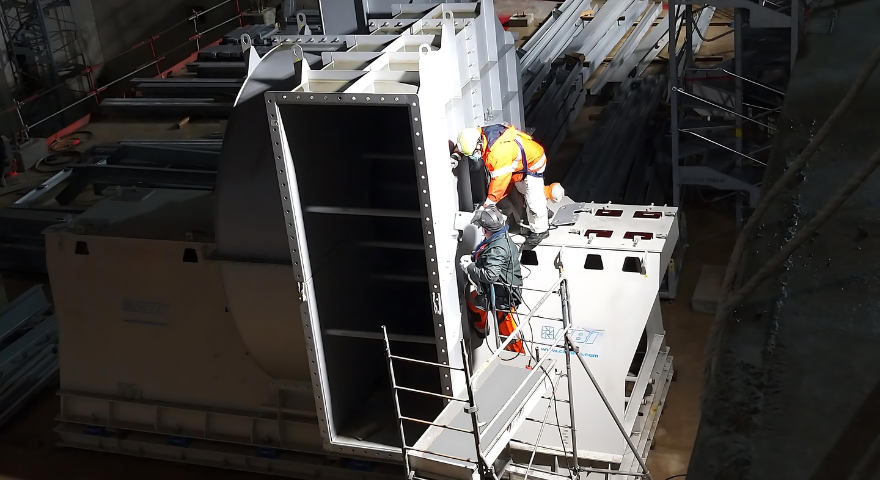
Selecting the type of centrifugal fan that best meets your needs combining both performance and durability can be challenging. This is why CBI Group is committed to deliver high-quality, and customised products.
CBI Group is a leading company specialised in designing, engineering and manufacturing unique solutions aligned with the requirements of the applications, capable of seamlessly integrating into existing ventilation systems.
Our products are state-of-the-art, advanced machines renowned for their solid structure and constant performance even under the most challenging conditions. The precision of each detail, the assessment and careful selection of the materials, the high level of customisation we provide to our customers become added values to every project.
Would you like to know more about all the types of centrifugal fans we offer?
Contact us!